
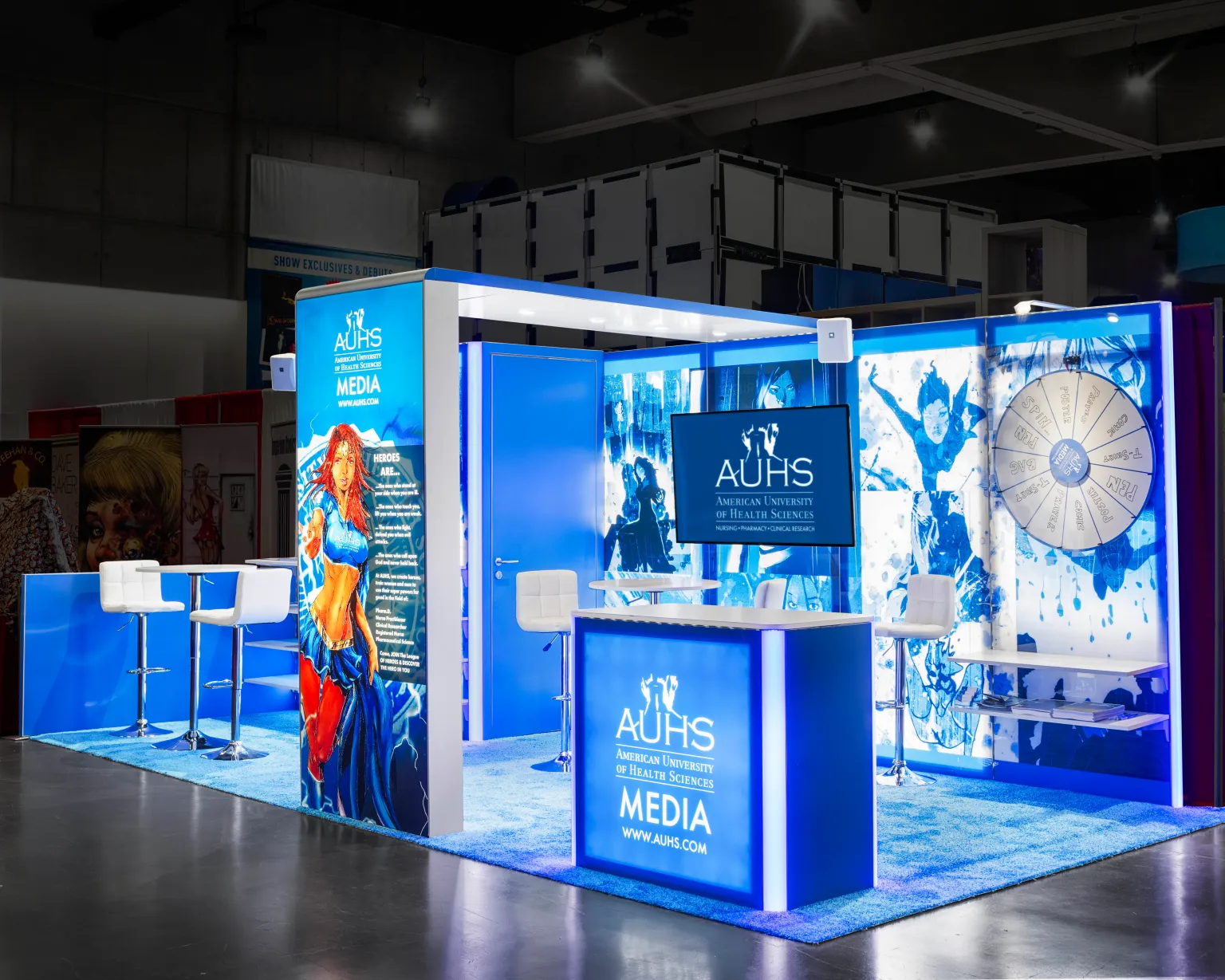
Venue fit
Modular Display Rentals
Planning should stay tied to the room and event rules that actually apply.
Operational focus
Rentals
The route, labor call, and closeout plan need one operating picture.
Next step
Coordinate early
The practical work starts by locking the venue, footprint, and support scope.
Modular Display Rentals planning compares speed, presentation, graphics, AV, furniture, freight, accessory tracking, return handling, and reuse across Daytona dates.
Modular Display Rentals is strongest when the rental path solves the room quickly without creating avoidable problems during install or strike.
Modular Display Rentals gives the team a practical way to decide what to rent, what to customize, and what has to survive later shows.
South Coastal Volusia covers Port Orange, South Daytona, Ponce Inlet, New Smyrna Beach.
West Volusia and Flagler Expansion — DeLand, Downtown DeLand, Orange City — is a different environment. Inland and northern markets extend the location stack into regional event, expo, and conference demand that is still realistic for Daytona crews, trucking, and venue coordination.
Execution priorities
- Match modular display rentals to the actual venue and event conditions.
- Lock freight, labor, and utilities into one schedule.
- Keep approvals and closeout items visible to the full team.
- Plan the next show before the current one finishes.
Daytona Beach as a trade show city
Modular Display Rentals is strongest when the rental path solves the room quickly without creating avoidable problems during install or strike.
Modular Display Rentals gives the team a practical way to decide what to rent, what to customize, and what has to survive later shows.
The Daytona Beach meetings section describes the market with 205,000 square feet of meeting space and 23 miles of beaches.
Daytona Beach as an up-and-coming bleisure destination and links to a claim that it is one of the top five U.S. Growth markets for meetings — a useful reference point when sizing a project.
The main Daytona Beach event areas
South Coastal Volusia covers Port Orange, South Daytona, Ponce Inlet, New Smyrna Beach.
West Volusia and Flagler Expansion — DeLand, Downtown DeLand, Orange City — is a different environment. Inland and northern markets extend the location stack into regional event, expo, and conference demand that is still realistic for Daytona crews, trucking, and venue coordination.
Daytona Beach labor and venue services
There is no single labor model for Daytona Beach trade shows. The right approach depends on the specific venue and the show organizer's contracts.
Practically, that means pulling the current exhibitor manual for every show and confirming a handful of items in writing: which tasks the venue's house crews cover, which tasks the show's general contractor covers, and what an exhibitor or their appointed contractor can handle without escalation.
No public venue-wide union-only or non-union-only policy was verified from the current public sections reviewed for Daytona's meeting hotels and off-site venues, so labor promises should stay tied to each show's manual, house provider rules, and venue approvals.
Daytona Beach convention venues and meeting properties
Every Daytona Beach show takes place in a specific building with its own rules. The venues below come up most often on our production calendar.
The plan has to match the specific building.
Hilton Daytona Beach Oceanfront Resort is one of the anchors.
Hard Rock Hotel Daytona Beach: oceanfront conference hotel featured by the destination marketing organization for its 8,300-square-foot Rock Royal Terrace and its fit for beachfront meetings, receptions, and activation-driven programs.
Scope on a modular display rentals project
A full engagement covers scope development, fabrication or rental, graphics, show services, logistics, and on-site execution from move-in through dismantle.
Individual projects layer or remove items based on scope.
A bad one has many, because they weren't.
Multi-show programs add asset management: storage, refurbishment, graphic swaps, and scheduled re-kitting so the booth rolls cleanly from Daytona Beach to the next city on the calendar.
Out of scope by default are show organizer fees, booth lease costs paid directly to the show, staff travel and per diems, and any custom software or data-capture tooling the client runs on its own stack. Those stay on the client side and plug into the project through coordination, not rebilling.
The process from start to finish
Every engagement begins the same way. From those four inputs, a real plan can be built.
After the brief, the work turns to the building itself.
Production covers fabrication, graphics, AV spec, rentals, and crew chief assignment. It is the longest phase of most projects and the one where timelines are either protected or lost.
Install days are owned by a single on-site lead.
Throughout show hours, the on-site lead stays present.
Strike and closeout happen the same day.
Cost and lead time
Every project has the same cost drivers.
Six variables drive the cost: custom versus rental, booth footprint and complexity, venue-specific labor and rigging fees, graphics scope and substrate, freight distance and timing, and the number of on-site supervision days.
Lead time drives everything. Custom: 16 to 20 weeks. Rental: 8 to 12.
How project performance gets measured
The measure of a good engagement is simple: on-time install, no venue callouts, clean show hours, and a closeout that makes the next event easier to book.
Most programs in Daytona Beach are evaluated on lead-capture volume, meetings booked on the floor, and qualified-pipeline attribution after the show. The booth is a means to those numbers — it is not the number itself.
A week after the show, the booth's actual floor performance is already clearer than any pre-show projection. We document those observations alongside the technical closeout so the next cycle inherits real signal, not nostalgia.
Why Trade Show Services of Daytona
Trade Show Services of Daytona keeps the work local.
Working with a Daytona Beach-based shop matters most when something goes wrong on-site. Solutions live within driving distance instead of on another coast.
Consistency across show dates is the other reason to hire local. The same crew that built the booth runs the install, knows the pack-out, and catches the small things — a missing hardware pack, a graphic edge that needs reseating, a storage crate routed to the wrong bay — without needing the client team to intervene.
Modular Display Rentals planning questions
Do you work at Hard Rock Hotel Daytona Beach?
Yes.
How does labor work in Daytona Beach?
It runs venue by venue.
How much lead time is ideal?
Custom builds run best with 16 to 20 weeks of lead time. Rentals take 8 to 12 weeks.
What information kicks off a project?
The show, the venue, the booth number, the dates, and a target budget range. From those, an initial scope and a realistic cost come back within a few days.
Who runs the booth on-site?
One named show-site lead runs the install, the show hours, and the strike. That person carries the floor plan and the punch list from crates to doors and reports up once a day.
Can the booth travel to the next city on our calendar?
Same structure, swappable graphics, standard crates.
What happens if something breaks during show hours?
The on-site lead handles it.