
Venue fit
Deltona, FL
Planning should stay tied to the room and event rules that actually apply.
Operational focus
Locations
The route, labor call, and closeout plan need one operating picture.
Next step
Coordinate early
The practical work starts by locking the venue, footprint, and support scope.
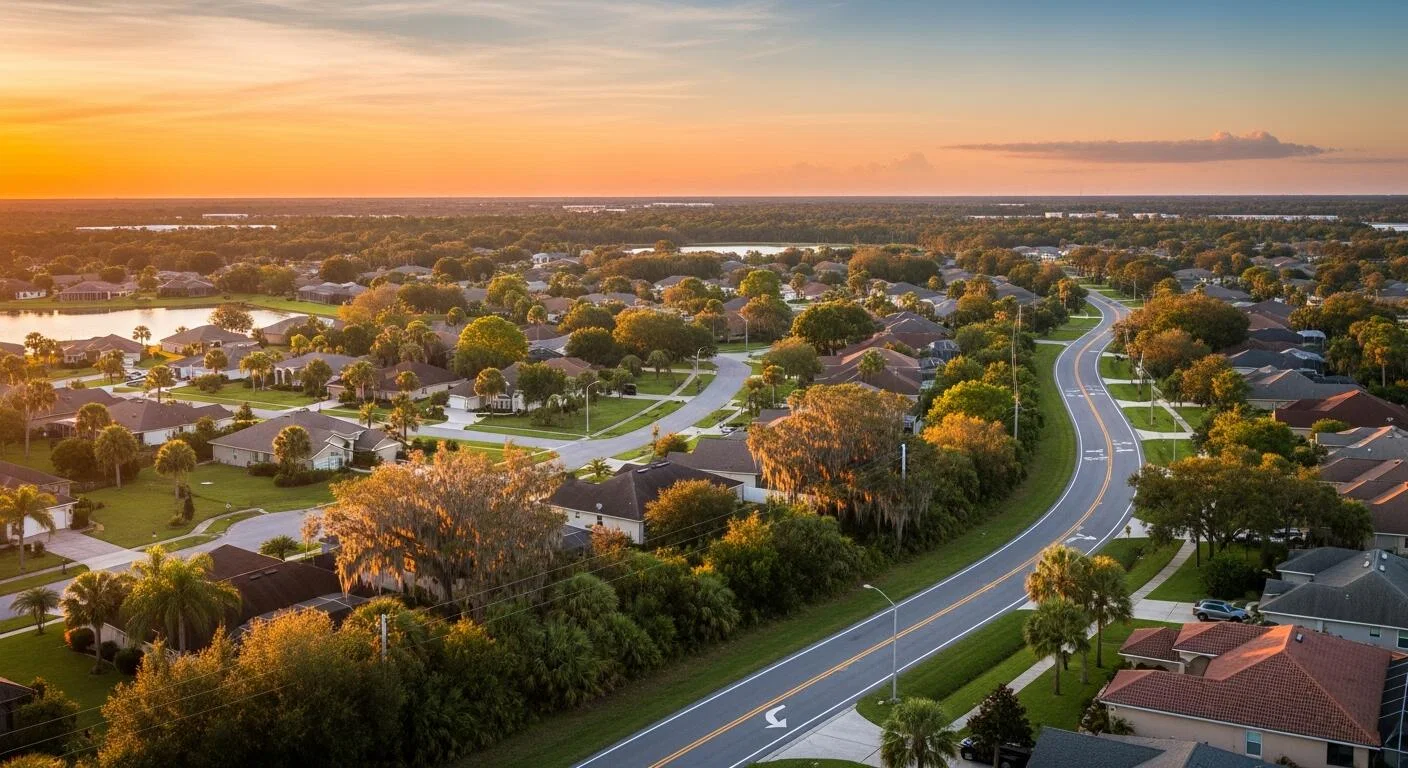
Deltona is, by population, the biggest city in Volusia County, yet it was built almost entirely as residential subdivisions starting in the 1960s and has never developed a downtown convention hall, hotel ballroom, or exhibit hall of its own. Any trade show tied to a Deltona address is planned around that fact from the start.
The city sits inland along the Lake Monroe shoreline and the St. Johns River basin, bounded by Providence Boulevard, Howland Boulevard, and Doyle Road as its main arterials, with I-4 running along its southern edge near exits 108 and 111. That road network is what actually matters for show logistics, since it determines how fast a crew or truck can reach the Speedway district or the oceanfront venue corridor.
For Trade Show Services of Daytona, Deltona work almost always means a client or sponsor whose office, warehouse, or residence is in the city, with the actual event held at the Ocean Center or one of the oceanfront hotels thirty-five to fifty minutes east. Planning treats Deltona as an origin point for people and vehicles, not as a venue location.
Execution priorities
- Confirm the actual venue early, since Deltona itself has no exhibit hall or ballroom.
- Route freight and crews along I-4 from the Deltona side toward the Speedway or oceanfront corridor.
- Build extra drive-time buffer for Deltona's size and its distance from the interstate's core.
- Use Deltona as an efficient staging point for a broader west Volusia service run.
- Keep pre-show meetings and approvals local when the client's team is based in Deltona.
A large city with no event venue
Deltona's population, at roughly ninety thousand residents, exceeds every other city in Volusia County, including Daytona Beach itself. That scale did not come with convention infrastructure — the city was platted by developers as single-family subdivisions and has stayed residential in character, with commercial development concentrated along Howland Boulevard, Providence Boulevard, and Saxon Boulevard rather than around any civic or exhibition center.
That means a trade show connected to a Deltona business or resident is essentially never held in Deltona. The planning conversation starts by locating the real venue — almost always the Ocean Center or an oceanfront hotel — and building the freight and labor plan around that building.
The I-4 corridor and drive times
Deltona sits south of Orange City and DeBary along I-4, with its own interchanges at exits 108 and 111 feeding into Howland Boulevard and Saxon Boulevard. From those interchanges, the drive east to the Speedway district runs roughly thirty minutes, and continuing on to the oceanfront venue corridor adds another fifteen to twenty depending on the specific hotel or resort.
Because Deltona's developed footprint is large and spread out, the actual drive time for a given crew or vehicle depends heavily on which part of the city they are starting from — the west side near Lake Monroe adds meaningfully more time than the east side near the I-4 interchanges.
Freight staging for Deltona-connected shows
Advance freight for a Deltona client's show is staged at or near the actual venue rather than in Deltona itself, since there is no warehouse or dock infrastructure in the city built for trade show cargo. Deltona's role in freight planning is mostly as a pickup or drop-off point for smaller local deliveries feeding into the main freight run.
For larger shipments, routing runs directly from the shop serving the Daytona Beach book to the venue's dock, timed to the move-in schedule, with Deltona factored in only as a fixed origin point for personnel and light cargo.
Lake Monroe and the St. Johns River edge
Deltona's northern edge runs along Lake Monroe and the St. Johns River, giving the city a waterfront it rarely gets credit for outside the immediate area. That geography doesn't factor into most show logistics directly, but it does explain why the city's road grid bends the way it does and why some of the older, established neighborhoods sit closer to the lake than to the I-4 corridor.
For crews unfamiliar with the area, understanding that Deltona is split between a lake-adjacent north side and an I-4-adjacent south side helps set realistic expectations for pickup and drop-off timing on any local leg of a job.
Labor rules stay with the venue
Regardless of where a client's Deltona office sits, labor jurisdiction, union rules, and exhibitor manual requirements follow the venue that is actually hosting the show. The Ocean Center and each oceanfront resort ballroom have their own house rules, and those apply in full no matter how far the client's home base is from the building.
What Deltona's distance does affect is scheduling: a Deltona-based team's on-site labor call needs to account for the commute, and pre-show coordination calls or walkthroughs are often more efficient done locally before the group travels to the venue together.
AV, graphics, and booth production
Booth graphics, signage, and AV equipment for a Deltona client's show are produced and staged out of the shop serving the full Daytona Beach territory, not locally in Deltona. Proofing and approval steps can typically happen remotely or during a local meeting near the I-4 corridor, keeping the client's involvement efficient without requiring travel to the coast until install week.
Delivery of finished materials is timed to the venue's dock and move-in window, following the same schedule used for any other client in the service area regardless of where their home office sits.
Show-week sequence for Deltona clients
The typical sequence starts with a venue and scope confirmation call several weeks out, followed by freight and labor scheduling set up around the actual building. In the days before move-in, crew and material staging shifts toward the venue itself; Deltona stops being the operational center of the job once install begins.
During the show, a Deltona-based exhibitor team commutes daily along I-4; after closeout, freight and equipment either return to the Deltona area or move directly to the next scheduled job, a decision made before dismantle so nothing sits idle.
Deltona inside the west Volusia service zone
Deltona sits at the southern edge of the west Volusia cluster that also includes Orange City, DeBary, DeLand, and Lake Helen. Trade Show Services of Daytona treats this group as one planning zone, which means a crew or vehicle staged through Deltona can frequently combine a stop there with a nearby community on the same run.
That regional approach keeps travel efficient for any client with contacts or facilities spread across more than one of these west Volusia towns, rather than treating each one as an isolated service call.
Working with Trade Show Services of Daytona from Deltona
For a Deltona-based client, the process starts the same way it does everywhere in the service area: confirm the venue, dates, and footprint, then build freight, labor, and production plans around that specific building. Deltona's size and distance from the coast are treated as fixed logistics variables, not obstacles that change the scope of work.
From there, the same Daytona Beach-based planning, freight, labor, and production teams handle the job, with the Deltona relationship staying centered on scheduling, approvals, and staging rather than on-site venue operations.
Frequently asked questions
Does Deltona have a convention center or exhibit hall?
No. Deltona is Volusia County's largest city by population but was built as residential subdivisions with no convention venue. Shows tied to Deltona clients are held at the Ocean Center or an oceanfront hotel, typically thirty to fifty minutes east.
How long is the drive from Deltona to the Ocean Center?
Roughly thirty-five to fifty minutes depending on which part of Deltona the trip starts from and which I-4 interchange is used, plus additional time during show-week traffic near the Speedway district.
Why doesn't freight get staged directly in Deltona?
There's no dock or warehouse infrastructure in Deltona built for trade show cargo. Advance freight is staged near the actual venue instead, with Deltona serving mainly as a personnel and light-delivery origin point.
Do Deltona's size and layout affect scheduling?
Yes. Deltona's developed area is large and split between a Lake Monroe-adjacent north side and an I-4-adjacent south side, so drive times for pickups or crew calls vary depending on which part of the city is involved.
Can a Deltona stop be combined with other west Volusia locations?
Often, yes. Deltona sits inside the same west Volusia planning zone as Orange City, DeBary, and DeLand, so a single crew or vehicle run can frequently cover more than one of these communities.
Does labor jurisdiction change for Deltona-based exhibitors?
No. Labor rules follow the venue hosting the show, not the client's home city. A Deltona-based team works under the same house rules and general contractor jurisdiction as any other exhibitor at that venue.